Selectivity Takes Its Name From the Rule That Chooses What Survives
Selectivity is named for the decision at the center of every reduction. Some parts of an input are necessary to preserve the behavior under investigation. Other parts can disappear. The engine discovers useful deletions by applying a rule supplied by the developer, over and over, to progressively smaller candidates.
That rule is the predicate. It might recognize a specific crash, a disagreement between two parsers or a configuration combination that produces the wrong result. The same input can reduce differently under a different predicate, because a different question makes different material relevant. The name points to that dependence. Selectivity chooses what survives according to an explicit test.
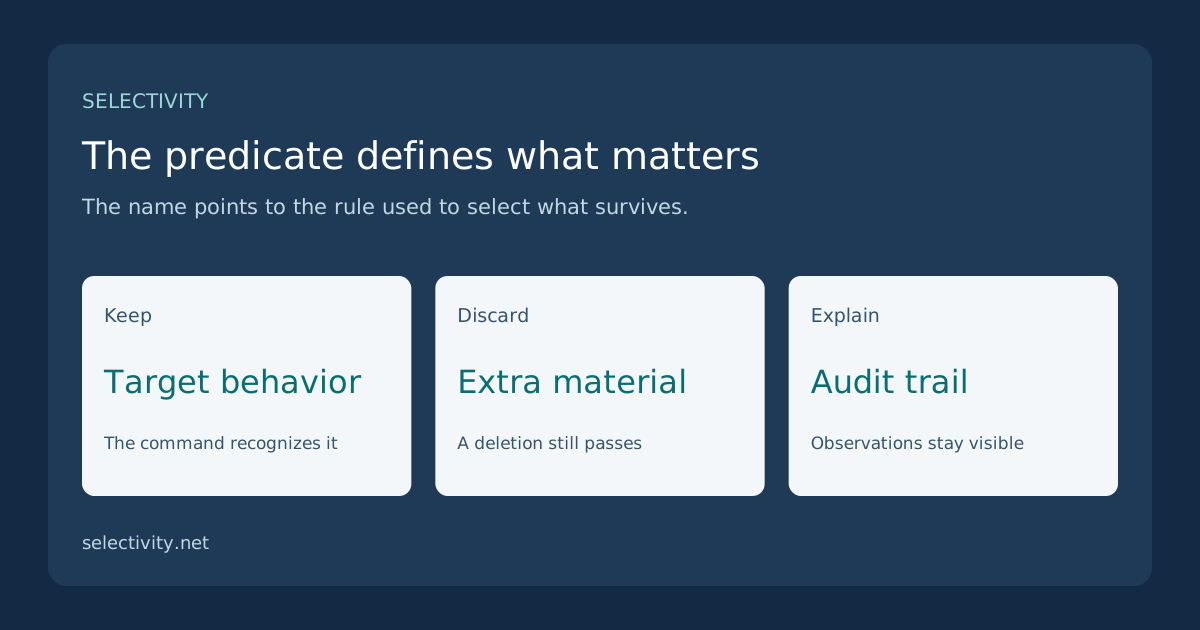
There is no claim that the tool understands the meaning of a bug report. Its first version works through deletions, with the command deciding whether each candidate still qualifies. That limited operation is useful precisely because the decision remains inspectable. You can read the wrapper, see the exit status and follow the recorded removals without guessing what an automated summary decided was important.
The name also leaves space for inputs beyond a single kind of text file. The released engine handles file lines and directory contents. Future structure-aware reduction would need its own validity rules and tests before becoming part of the product. For now, the quick start gives the smallest useful expression of the idea: supply an input, define what must survive, and inspect what remains.